
You’re a fintech VP of Engineering facing tight timelines. Your Series B board wants a PSD2-compliant payment platform live in 90 days, scalable to 10,000 transactions per second, delivered by people who’ve done regulated work before.
The wrong partner can cost you months and a painful audit. While most dev shops focus on writing code, few understand that fintech software development for scale-ups starts with compliance-first architecture.
We evaluated firms on proven compliance expertise, payment and lending experience, growth-stage delivery, senior leadership, and AI-accelerated practices. These eight have shipped real production systems in regulated markets — built for audits from day one.
8 Best Fintech Software Development Companies
The firms below represent distinct approaches to regulated fintech engineering. Some bring decades of PSD2/PCI DSS specialization, while others layer AI acceleration onto compliance-first workflows.
All have shipped production systems that passed regulatory scrutiny, making them strong partners for fintech software development for scale-ups that need to balance compliance, product velocity, and long-term scalability.
Euristiq
Euristiq launched in 2016 and specializes in the overlap of digital transformation, custom software, and AI automation. This mix proves valuable for growing fintechs that must modernize legacy systems while staying compliant and keeping everything running smoothly.
Their strength lies in AWS work and legacy modernization. They help teams shift payment rails, KYC processes, or lending engines from rigid monoliths to flexible cloud setups — without losing control over audits or data sovereignty.
The real difference? They prioritize throughput and cost efficiency over basic feature delivery. In fintech, that focus is crucial. Spiking volumes or tight reporting windows can expose weak infrastructure fast, turning technical debt into a genuine business threat.
They shine with mid-stage fintechs that need targeted re-platforming rather than full rebuilds. With the right AWS tools and automation, timelines shrink, and daily operations become much lighter.
Key strengths:
- AWS-certified consulting for regulated cloud migrations
- AI automation integrated into SDLC and ops workflows
- Legacy modernization without greenfield rewrites
- Focus on performance optimization and cost efficiency
- Digital transformation strategy aligned with fintech compliance needs
SPD Technology
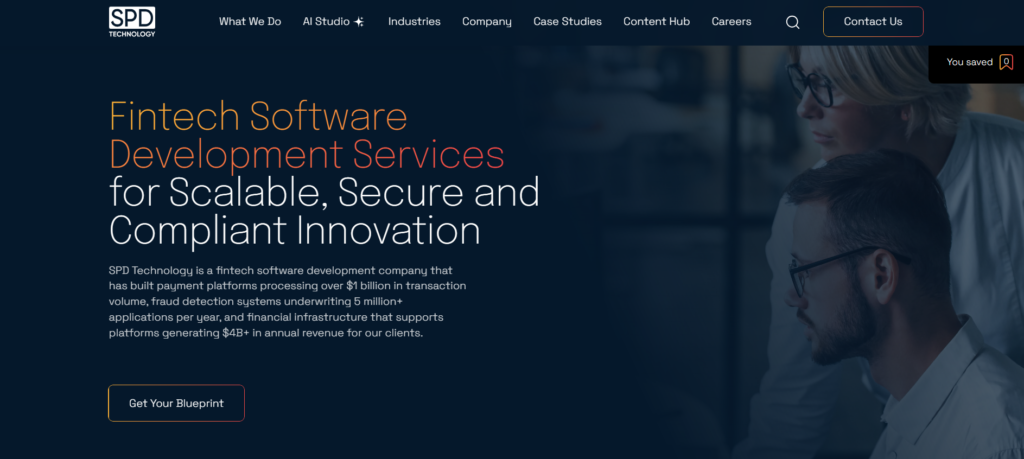
Founded in 2006, SPD Technology brings more than 18 years of experience in fintech software development for scale-ups and established companies operating in regulated markets.
The company specializes in custom payment platforms, billing systems, digital banking solutions, and AI-driven fintech products, with compliance built into the architecture from day one. Their teams develop PSD2- and PCI DSS-compliant systems for clients across the UK, US, and EU, helping businesses meet regulatory requirements without slowing product delivery.
Unlike traditional outsourcing providers, SPD Technology operates as a product engineering partner, embedding senior engineers into client teams and supporting products throughout their growth cycle.
This long-term approach is particularly valuable for scale-ups that need fintech software development support as transaction volumes increase, payment infrastructure expands, and compliance obligations become more complex.
Their experience building production-grade payment and banking platforms enables clients to scale from early growth stages to enterprise-level operations while maintaining the auditability and reliability regulators expect.
Key strengths:
- 18+ years specializing exclusively in regulated fintech infrastructure
- PSD2/PCI DSS compliance architected from sprint zero, not retrofitted
- Cross-border delivery experience across the UK, US, and EU regulatory regimes
- Senior engineers embedded for long-term partnership, not project handoff
- Production-grade payment platforms built to scale under regulatory scrutiny
KindGeek
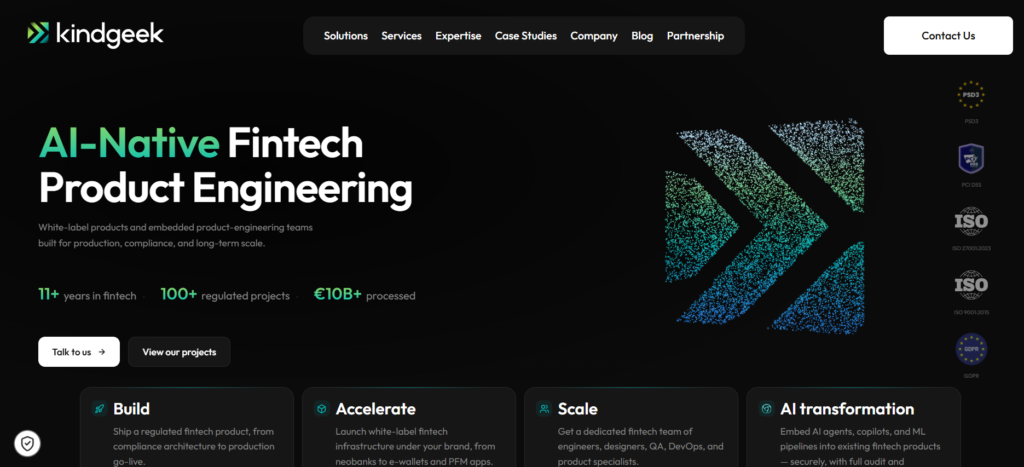
Founded in 2015, KindGeek operates under a singular constraint: every project is a regulated fintech. No e-commerce diversions, no SaaS side hustles. Every engineer on the roster has shipped compliant products—PSD2 payment rails, PCI DSS card processing, KYC/AML workflows—which means you’re not training a generalist team on regulatory nuance mid-build.
Compliance is architected into the system from sprint zero, not retrofitted during a panicked pre-launch audit when you discover your data model violates GDPR or your API lacks proper tokenization. That front-loaded discipline prevents the costly rewrites that sink underfunded growth-stage companies.
AI is integrated into design, code review, and delivery—automated compliance checks, pattern recognition for regulatory edge cases, and accelerated testing cycles. It’s not AI-for-AI’s-sake marketing. It’s tooling that compresses timelines without sacrificing the architectural rigor fintech demands.
Best for teams building payment platforms, lending infrastructure, or digital banking products where compliance failures have serious legal and financial consequences.
Key strengths:
- All projects are regulated fintechs—zero diversification into non-compliant verticals
- Compliance embedded in architecture from day one, not post-build audits
- AI tooling accelerates code review and regulatory pattern detection
- Every engineer has production fintech delivery experience
- Pricing structure and engagement models aren’t published—requires a discovery call for budget alignment
DashDevs
DashDevs started in 2010 and offers deep expertise in payments and lending for growth-stage fintechs in regulated markets. They mix solid product engineering with commercial and compliance insight, helping CTOs tackle technical debt and regulatory risks at the same time.
What separates them is their proven experience with BNPL platforms, one of fintech’s toughest compliance areas. They’ve built live systems where risk model errors can quickly cost millions in chargebacks or penalties.
They’re especially valuable for companies needing PSD2 compliance, multi-currency setups, or lending processes that must pass SOC 2 audits. Best suited for teams that want strategic engineering leadership—not just another dev shop treating compliance as a simple checkbox.
Key strengths:
- 16 years of production fintech—payments, lending, embedded finance
- Senior engineers who’ve architected regulated products end-to-end
- BNPL expertise: risk models, KYC flows, regulatory reporting
- Commercial instinct: they challenge the scope when it creates technical debt
- Boardroom fluency: can explain trade-offs to non-technical stakeholders
Itexus
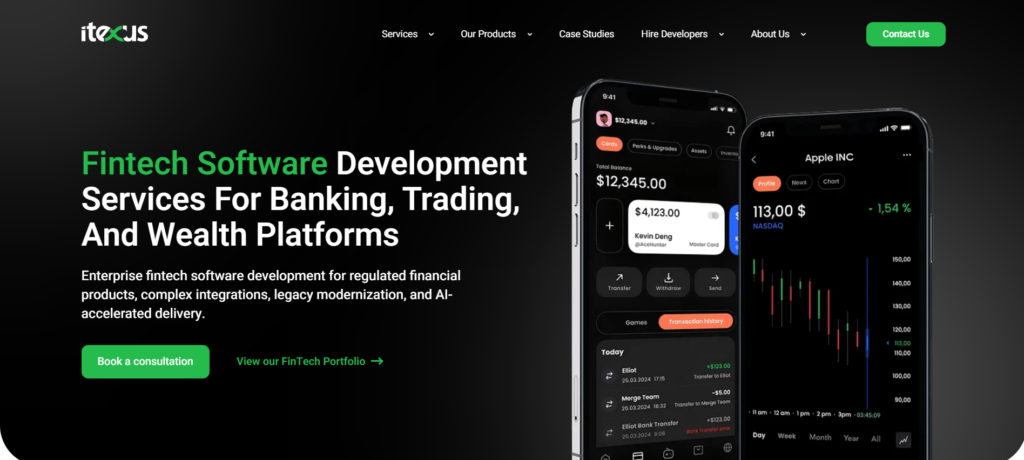
Itexus was founded in 2013. Since then, the company has built deep enterprise fintech expertise, delivering fintech software development for scale-ups and established financial businesses operating in regulated, high-volume markets.
What really stands out is their track record—over 300 completed projects across payments, lending, wealth management, and digital banking.
Their real edge comes from the quality of their engineers. These are Ph.D.-level professionals who understand both the theory behind distributed systems and the practical side of meeting PCI DSS, PSD2, and SOC 2 standards. They architect solutions that plan ahead for regulatory reviews, build in scalability early, and leverage AI tools to move faster while keeping everything solid.
This makes Itexus ideal for companies that want more than a basic product. They deliver infrastructure that can manage heavy transaction volumes, survive audits, and scale naturally as your business grows.
Key strengths:
- 300+ fintech projects across payments, lending, and digital banking
- Ph.D.-level engineers with deep systems architecture expertise
- AI-accelerated SDLC for faster, compliant delivery cycles
- Enterprise-grade solutions designed for regulated, high-load production environments
- Compliance-first architecture baked into sprint zero, not retrofitted later
The Codest
The Codest launched in 2020 with a product-first focus on fintech engineering and digital banking for scale-ups. Rather than treating compliance as an afterthought like many dev shops, they build it into the architecture from day one.
They stand out by offering hands-on senior technical leadership that shapes the roadmap early, not just during crises. Using AI tools, they accelerate code reviews, testing, and deployments while preserving quality and rigor.
This approach works especially well for growth-stage fintechs that need to move fast without compromising compliance. Their engineers don’t simply execute tickets—they question assumptions, suggest improvements, and push back on risky shortcuts.
Key strengths:
- Product-minded engineering with CTO-level strategic input
- AI-accelerated SDLC for faster, higher-quality delivery
- Specialized in fintech, digital banking, and scale-up scaling challenges
- Hands-on architectural leadership from day one
- Modern tooling integrated into compliance-first workflows
Emerline
Emerline launched in 2011 and brings 15 years of experience to fintech builds that need both architectural strength and speed. Senior full-stack engineers in the USA and Europe work directly on your codebase—no junior handoffs or coordination issues.
They’ve added an AI-powered SDLC with OpenAI and Cursor to accelerate code reviews, testing, and deployments while staying compliant. For scale-ups, having web, mobile, desktop, and startup development all under one roof is a real plus. It helps avoid multi-vendor headaches when you’re racing toward Series B and audits.
Keep in mind that their portfolio goes beyond fintech, so dig into their compliance expertise during discovery. Ask for PSD2 or PCI DSS examples specifically. They work fast, but it pays to confirm their architecture truly fits fintech standards upfront.
Key strengths:
- 15 years of shipping production systems across regulated and high-growth markets
- Senior engineers in US/EU time zones—no handoff lag
- AI tooling (OpenAI, Cursor) integrated into the SDLC for faster sprints
- Full-stack coverage: web, mobile, desktop, startup MVP to scale
- Multi-vertical experience—verify fintech compliance case studies before contracting
Leanware
Leanware launched in 2020 as an AI-first engineering firm where the same senior engineer scopes and builds your project. This eliminates the discovery-to-delivery handoffs common in traditional outsourcing.
In fintech, that makes a real difference — the architect familiar with your compliance constraints is also writing the code, reducing context loss and future debt.
They provide AI ROI Assessment, Custom AI Agents, and Dedicated AI Teams tailored for growth-stage companies. These services add smart features to payment flows, fraud detection, or onboarding without major rebuilds. Based in Bogotá with US hours and a 5.0 Clutch rating, they rank 8th due to a narrower fintech focus.
If you need AI layered onto existing systems, their accountable model limits scope creep and supports quicker iteration.
Key strengths:
- Senior engineers own projects from architecture through deployment
- AI-native tooling integrated into the SDLC from day one
- US timezone alignment with Latin American cost structure
- Clutch 5.0 rating across client engagements
- Specialized in AI agents, ROI assessments, and dedicated teams
Conclusion
Growth-stage fintech companies often face a clear fork in the road. You can work with teams that truly understand compliance-first architecture, or you risk burning runway on code that won’t hold up in regulated markets.
The eight firms we’ve covered stand out because of their real PSD2 and PCI DSS experience, senior-led design, and smart use of AI to speed things up without skipping audit requirements. They’ve built production systems for scale-ups handling payment rails, lending platforms, and cross-border rules — making them strong choices for fintech software development for scale-ups rather than just early-stage MVP delivery.
Your next move? Map out your specific regulatory needs, then reach out to three of these companies whose expertise fits your market. Ask for architecture proposals, compare how they run discovery, assign senior engineers, and set delivery milestones. That process quickly shows who builds robust systems and who just writes code.